The transcripts are AI-generated from the UN's English audio and can contain mistakes. We are checking them against the statements the missions publish; some errors are still expected.
Mr. president, Papua New Guinea comes to this assembly with profound respect for the charter of the United Nations and for the principles and purposes upon which this great institution was founded. The United Nations reminds us that whether we are big or small nations, rich or poor nations developed or developing, powerful or less powerful, we are all members of one international community. The challenges confronting humanity do not recognise the size of our economies, the strength of our militaries, or the boundaries on our map. No nation can address them alone. We must therefore continue to work together, respecting the sovereignty of all nations, upholding the international law and the United Nations Charter, resolving our differences peacefully and recognising that every nation, regardless of its size or economic strength or military might, has a voice and a place in this assembly. For Papua New Guinea and all the nations of the Pacific, multilateralism matters. The United Nations place provides a place rather, where small nations can sit alongside the largest, where voice can be heard and where we can work together on the common challenges facing humanity. And with this, I want to place on record Papua New Guinea's fullest acknowledgement on all speakers from the Pacific who have spoken, all leaders who spoke. We are fully, on behalf of Papua New Guinea, affirm all their points, the points that was raised. I also wish to acknowledge the Secretary General of United Nations, His Excellency Antonio Guterres as he approaches the completion of his tenure on behalf of the government and people of Papua New Guinea. I want to thank the Secretary General for his strong and consistent advocacy for humanity. At a time when our world has confronted war, displacement, poverty, inequality, climate change and many other challenges. He has consistently called for peace, human dignity, international cooperation and respect for the principles of United Nations. He has demonstrated the qualities of a global statesman. If there is anyone befitting of a Nobel Peace Award and label a global statesman, His Excellency Guterres is perhaps the leading person at this time. He has used his office to speak for humanity, including those voices that are often too dim and seemingly unheard. Secretary-General Guterres, on behalf of my 11 million people, Papua New Guinea, thank you for your service to the United Nations and to humanity. We remember fondly your three nights you stayed with us in the mountains and islands of Papua New Guinea. Thank you for being a strong voice of not just Papua New Guinea, but small nations, especially my small Pacific island nations. Your advocacy reminds us that beyond our national borders and political differences, cultures and beliefs, we belong to one human family. And we share one planet called the planet earth. Mr. president, it is in the spirit of common humanity that I wish to speak about human rights, human freedoms, and particularly freedom of conscience, thought, belief, and religion.
Dear friends. Since this morning, we've heard a number of speeches from this rostrum about the state of the world, and I fear I will not be very original in my description. Every speaker has described the return of imperialism, of arrogance, the return of unrestrained force which knows no rules, a world in which we see power concentrated in the hands of the few, a world in which some believe that they can undermine the international order so as to push their borders outwards. Those that believe that people's sovereignty can be toppled over that they could use that sovereignty. People who believe that they can decide the fate of the planet, whether that be as regards the climate or AI. The question we must answer is very simple. The question is, do we want to live under this state of affairs with a return to the law of the jungle? Or do we want to live in a civilised international society? Our duty today, more than ever, is to hold firm here at the United Nations in order to make decisions to further our common interests so that people can choose their fate freely, their development model choose their future. To refuse their sovereignty being taken hostage by unjust forces, by fear. Therefore, the very raison d'etre of this organisation is to bring together free people on an equal footing. It is our charter that prevents the power wielded by some from making decisions for others. This is what compels us to work together to demonstrate our commitment and our capacity to act, and usefully so. You know just how committed France is to the United Nations and its ability to shoulder the responsibilities conferred upon it by the charter. I wish to reassert our commitment to take action hand in hand with each and every one of you, so as to revive multilateralism and to demonstrate that we are stronger, more effective, more capable of tackling common challenges if we do this together. Today's challenges, future challenges, ones we do not know about yet, challenges we haven't yet tackled. I talked about the climate. It also applies to war and peace, new technologies and development. Across all of these areas, wherever might is right is being imposed, we must defend justice and our common interests, and it is in the interests of each and every one of us as well, because our charter affords us the protection, the right to live together. Given the sorry state of the world, given what we're seeing today, and that is a growing number of wars we haven't solved, multiplying myriad crises and contemporary challenges which are weighing on new generations in new ways, I believe we are duty bound not to yield. And at the end of the day, the message I wish to convey to you today, as I've been doing over the last nine years, is a message of determination. Optimism through action. What I'm trying to tell you is that we will not yield to fatalism, to defeatism, which is very much in vogue according to this rhetoric. There's not much point coming here to deliver speeches. They say might is right. We can impose a different kind of peace. That is what they say.
Excellencies, the digital revolution gives. Give us the issue and in turn an entirely new dimension. Billions of people now consult maps every day on their phones, their computers and digital platforms Children, for example, discover the world through the digital maps. The businessmen make decisions using cartographic data. The government also rely on special information and artificial intelligence systems increasingly interpret our planets through digital data and cartographic representation The question before us, therefore, is no longer only about a printed maps, it's about the digital image of our planet that we are transmitting to the generation of tomorrow. Ladies and gentlemen, we also want correct the map to become a dialogue between generations. We want young people to have the opportunity to look at our planet with a fresh eyes. We want schools, universities and research institutions to become places where the representation of our world have a can be, can be studied and understood.
Mr. president, excellencies, my friends, we meet at a time when the obstacles confronting human progress are multiplying, obstacles to peace, obstacles to food and clean water, obstacles to finance, medicine and education, obstacles to movement and opportunity. Obstacles to technology, to the knowledge and infrastructure needed to use it, and increasingly, obstacles between nations, between communities, and between people who no longer agree on the same facts or trust the same institutions. War continues to destroy lives and communities. Even though the international community possesses more tools than ever, ever before to prevent conflict and to facilitate dialogue. The climate crisis is accelerating. Even though the science is clear enough for us to act, and many of the solutions are already known. And despite unprecedented global wealth, millions remain without reliable access to food, water, health or shelter. These challenges, my friends, are creating the crises of which we constantly speak, and at the same time, new challenges are emerging. Artificial intelligence is opening extraordinary possibilities in health, education, science, and productivity while also creating new risk of exclusion, exploitation, surveillance and the distortion of truth. And yet, the cooperation needed to confront these challenges is under strain. It is why I believe the theme this year is so apt. Restoring trust. Managing transformation. A united nation that delivers for all. The theme reminds us that we have institutions created to preserve peace, to advance development, and yes, to protect human dignity. The institutions are these very United Nations. We have shared principles grounded in sovereign equality, and in the recognition that our responsibilities extend beyond borders. The reality is that we understand that there is, regrettably enough, for us to be able to invest in prevention rather than waiting to finance reconstruction. We understand enough about the climate crisis to reduce the emissions that are warming our planet, and take the necessary steps for our populations to adapt. We equally now understand enough about the rapid development of AI to know that as we welcome its promise, we must anchor its development in a universal, humanizing framework that does not imperil our existence as human beings. The failure, my friends, to address these challenges, therefore, is not one simply of knowledge or capacity. It is a repeated failure to convert what we know into what we do. To turn principle into practice and global capacity into solidarity So beneath our many crises lies yet another one. And yes, it is a crisis of responsibility. Mr. president, that responsibility begins here in these halls.
Own country · at 1 min · 2 mentions in this passage
Our military is the most powerful on earth. Our technology is second to none and we are leading in virtually everything. Our energy is fueling the planet. America is rising. Our nation is growing. Our power is expanding. Our country is doing better than ever before, and our future is very, very bright. Since I took office, we have created more than 1 million new private sector jobs, and more Americans are working today by far than ever before. Last week, it was announced that the poverty rate has reached its lowest level in American history. We lifted 1.5 million Americans out of poverty last year alone. Another record, the African American and Hispanic American poverty rates are at all time lows. Real household incomes for Americans have soared to the highest level in history, 87,000 on average, surpassing the prior record that I set in my first term. From day one, my administration has worked to remove every single unnecessary regulation and obstacle to doing business in America. We passed the largest tax cuts in American history, and as a result, more money is being invested in the United States right now than has ever been invested in any nation, anywhere in the world. U.S. stock markets have set all time records. And that's just in the last 12 months. We've secured commitments for $21 trillion in new investments from all over the planet, compared to less than $1 trillion in four years in the previous administration. Two years ago, our country was dead, and now we have the hottest country anywhere in the world. Before I took office, we had the worst and most dangerous border on earth. And now we have the most secure border in American history. Nobody comes in unless they're invited. Unless they have permission. In the past 16 months, zero illegal aliens have been admitted to the United States. And that's done by some very sophisticated people. It's not done by the Trump administration. Zero. As a result, last year we achieved the largest drop in violent crime ever recorded. The murder rate has plummeted to its lowest level in 125 years. Since the year 1900, I sent our crime busters into Memphis, Tennessee, and New Orleans, Louisiana, and crime in each place went down over 80% and will go down still further. More importantly, when I arrived on January 20th of last year in Washington, D.C., it was riddled with crime. And now crime is down 87% and we're going for 100. Tourism is, if you take a look and I guess a lot of you have been there. Tourism is thriving. Restaurants are bustling, and people are proud of our nation's capital. They're proud like never before. We've invested more money in the United States military in the past 12 months than ever before And this term, it will be $1.5 trillion. We inherited a dark Age of America from the previous administration, and we turned it into the golden age of America. The entire world is being lifted by the wealth, strength, spirit, and momentum of a newly energized and a very powerful United States of America. And just as we moved quickly to address problems we inherited at home, we have acted with decisiveness and speed to reshape the world stage and solve problems that have plagued us for far too long. Every leader in this room and your great leaders, many great leaders.
This purpose binds our national advancement to our continent's progress, and to our responsibility to contribute to a peaceful, equitable and prosperous world. We understand that governments and multilateral institutions and trusts, when their decisions improve lives. Yet none of these gains will matter if we turn a deaf ear to the trace gathering around our borders and further appeal, we inhabit the only planet known to sustain human life. And as long as that scientific park holds, we cannot pretend that we are insulated from complex as well geography or personal exemption from the consequences of a fractured world. Mr. president, we reject the false choice between development and climate action. Developing countries, most industrialised, eradicate poverty and expand energy access through low carbon pathways supported by technology transfer, capacity building and climate finance. Africa Contributes less than 4% of the greenhouse gas emissions yet via disproportionate consequences. Nigeria remains committed to the Paris Agreement and an equitable energy transition that reflects historical responsibility and capacity. While protecting people's right to development under our Energy transition Plan, we are working towards net zero emissions by 2060 while expanding access to affordable, reliable and sustainable energy. This approach combines renewable energy, clean cooking and gas as a transitional fuel with climate, smart agriculture and nature based solutions. Finance must be governed by equity and shared responsibility rather than charity. With international commitments translated into accessible, predictable and adequately funded mechanisms that enable developing countries to pursue climate action without compromising development objectives.
Excellencies, the Hindu Kush Himalaya is home to nearly 2 billion people. These mountains provide water, ecosystems, agriculture, and livelihoods to populations far beyond Nepal. The Himalayas are not peripheral to the planet; they are part of the planet's life support system. That is why, as an urgent first step, we propose that we establish a Himalaya climate resilience mechanism led by Nepal, India, and China. Through this mechanism, let us share satellite data and expertise, let us monitor dangerous glacial lakes, let us strengthen joint early warning systems, and when disaster strikes, let us coordinate assistance across borders. Let the Himalayas become a laboratory of international cooperation rather than a frontier of fragmented information. Remarkable for at least developed countries, Nepal is already playing a global role exceeding its ecological share. We have restored forests that cover nearly half of our territory.
However, we are convinced that our size shouldn't determine our ability to contribute, much less affect our own dignity. We need more effective, more representative multilateral institutions that are closer to the people and more able to respond to the challenges of our time. We need cooperation. We need solidarity and we also need to demonstrate austerity within these institutions. But above all, we need to restore trust in our collective ability to change things, because at its heart, the very idea of well-being and progress springs from something that is profoundly human, that is the ability to recognize suffering and refuse to accept inertia. Human beings are creative precisely because they refuse to resign themselves to things. They sense what causes pain, they sense what could be different, and then they are able to sense the desire for change. And this desire for change is perhaps one of the most profound expressions of our own freedom. When our people's advance along the path of progress, they generally do so by wielding the powerful magic of freedom, knowing that freedom doesn't involve solely choosing between different possibilities. It also means having being able to transform those things that we wish to for the good of the community as a whole. Our freedom becomes fuller when we are able to expand the freedom of others. When we change our societies through dialogue, when we build more, we build fairer institutions. When we undertake significant projects that endure beyond our own lifetimes When school and new school opens its doors, when a child has an opportunity that was previously out of their reach. When a community is able to overcome a division, when two countries that were at odds finally find a path towards understanding. Today, there are more than 8 billion people living on the same planet, 8 billion different stories, 8 billion hopes, 8 billion possibilities. We're not finished as such as humanity. We are a humanity still in the making. Every morning we have the chance to decide what kind of world we want to leave. To those who come after us, we can choose to accept inequality as inevitable. We could accept war as something permanent, accept poverty as our fate.
The selection of the next Secretary-General will be one of the defining moments of this session, and Kazakhstan supports a transparent, inclusive and merit based process conducted in full accordance with the Charter. Mr. president, the international security environment continues to deteriorate. World military expenditures reached a record $2.9 trillion in 2025. Our small planet is home to more than 12,000 nuclear weapons, each one capable of untold damage and sorrow. Every year we seem to lose more biodiversity, yet gain more armaments. For Kazakhstan's nuclear disarmament in particular, is not an abstract doctrine. It's a responsibility borne on the national experience. This year marks 35 years since the closure of the Semipalatinsk nuclear test site 30 years since the CTBT opened for signature, and 20 years since the signing of the Treaty on Nuclear Weapon Free Zone in Central Asia. Our experience of renouncing the world's fourth largest nuclear arsenal did not weaken our state to the contrary through international trust. It strengthens sovereignty, enhanced security and promotes development. Today the trust is again in danger. New START has expired. While the 2026 NPT Review Conference ended without substantive outcome for the third consecutive cycle. Nuclear weapon states must never confuse the absence of agreement with the vacuum of obligation. They remain responsible until we secure a world free of nuclear weapons. Kazakhstan advocates the relaunch of high level dialogue among nuclear powers, and is ready to host one of their next meetings. We will also continue advancing our earlier proposal to strengthen the BWC through establishing an international agency for biological security. Distinguished delegates. Peace and stability are prerequisites for sustainable development. We stand firmly for diplomacy and dialogue, and against the escalation of tension and the use of force.
Today, we highlight his exemplary contribution as a man of dialogue, an advocate of the United Nations Charter and the international law, a tireless advocate of the need to protect the planet from harmful effects of climate change, and a champion of the global debate on global governance of artificial intelligence. Mr. president, Your excellencies, the United Nations General Assembly is always held in the month of September. This year's session, however, takes place 25 years after the terrorist attack that destroyed the Twin Towers in New York and struck other targets on the American territory, causing thousands of civilian deaths, injuries, some of whom continue to bear physical and emotional scars to this day. I'd like to take this opportunity to once again condemn terrorism in all its forms, wherever it occurs.
Dear friends, as you know, climate change has become a global challenge. The average temperature of our planet and the number of climate related emergencies are rising rapidly, while the negative impact on energy, agriculture, food security and the economy as a whole has reached a significant scale. Kyrgyzstan is a mountainous country. We are particularly vulnerable to the effect of melting glaciers, and this is not an abstract threat. It is an environmental challenge of the regional significance. I believe it is extremely important and necessary to unite international efforts in addressing climate challenges and the problems facing mountainous regions. In this regard, the 21st 23rd October 2027, Bishkek will host the second Global Mountain Summit, Bishkek plus 25. Taking this opportunity, I invite all of you to participate in the summit. The summit will serve as the concluding event for the five years of action for the Development of Mountain Regions for 2023 2027 term. During my meeting with United Nations Secretary General Antonio Guterres in Bishkek on 31st August 2026, I proposed organizing this summit jointly with the organization. These efforts demonstrate our country's leading role among mountain states and its commitment to unite international efforts to address their challenges. Therefore, Kyrgyzstan stands fully ready to serve with the United Nations as the voice of small and developing countries in addressing the climate related challenges affecting mountainous regions. Distinguished heads of delegations. Continuing the topic of climate change, I would like to draw your attention to another environmental challenge. As we all know, global problems and disasters often have their origins at the local level.
Yes, but now it must also be digital. The change must then be reflected in the way we work together to achieve our different and common goals. I know that I am preaching to true believers, Mr. President and Mr. Secretary General, when I say that there must be no letup, no slowing down in the relentless, relentless drive for reform of how disunited nations and its agencies does its business and delivers its services, to take our foot off the gas would be to let down the millions who need this United Nations to do better, be better at tackling the problems that blight their lives. That is why the goal of this General Assembly, a United Nations that delivers for all, is so important and so urgent. If we are to have any hope of renewing the trust of the citizens with serving global institutions and the global order. We have to show that those institutions, this institution, can indeed deliver deliver in ways that change tangibly lives for the better. We must never lose sight and never lose faith in the values that brought us together in the first place. As nations united. Malta is and always, of course, will be a passionate advocate and promoter of and passionately committed to multilateralism. At the core of all we do must be the code and conscience of the founding charter of this United Nations. But the implementation of those values, the way we turn those fine words into fine actions, must always be a process of constant evolution. We can never stand still if we are to keep cooperation alive. So Malta remains thoroughly committed to the implementation of the pact for the future and all of its associated actions. Reforms must, yes, remain Member State driven and firmly anchored in the intergovernmental process, and efficiency must not come at the expense of effectiveness on the ground. Malta solidly backs a strong and effective resident coordinator system as the key anchor of UN action at a country level, and I can't reiterate often enough or restate strongly enough, that the only effective antidote to the cancer of cynicism and suspicion is effective and concerted action to tackle the greatest threat to our people and our planet. And alongside spreading conflict and the dangers of uncontrolled technology, the greatest threat to us all, and especially island nations like Malta, is man made climate change.
A United Nations that delivers for all. This theme invites us to consider international cooperation in a world that is subject to profound challenges for Equatorial Guinea. Trust is strengthened when we fulfill commitments that have been made and decisions that have been adopted collectively, and when visible results can be produced The countries of the Global South need cooperation that preserves peace, that drives sustainable and inclusive growth, and that expands the ability of each state to build its own future. Therefore, 21st century cooperation should provide opportunities for the mobilisation of financing to transfer, transform raw materials and to develop one's own knowledge and technologies. Excellencies, this vision is especially relevant for Africa, which needs investments that can allow it to develop local value chains, build infrastructure, advance industrialization, strengthen human capital, incorporate new technologies and generate employment. Especially for the continent's large youth population. A more productive and industrialized Africa will be a stronger partner for all of the To benefit to the benefit of all of those wanting to halt its emigration. Excellencies. When the 2030 agenda was adopted, the world embraced its deeply human vision. Eradicating poverty, protecting the planet. And making sure that all people can live with dignity. Leaving no one behind. However, as we approach its end date, we are far from meeting its goals. Poverty persists, inequality is expanding, and climate change continues to rage. It is clear that we need an international financial architecture that facilitates productive investments, that takes into account the real vulnerabilities of developing countries, and supports the efforts of each nation. It is therefore urgent to implement the resolutions adopted at the conferences in Addis Ababa in 2015 and in Serbia last year.
Mr. president, 80 years of patience is enough. The time for structural reform is now. While we welcome the UN 80 reform agenda to make this organisation a. And accountable true reform must address the core structural issue. The UN Security Council article is home to 1.5 billion people and account for nearly one third of the UN membership. Yet 80% 80% of Security Council mandates concern Africa peace and security, while Africa remains without a single permanent seat on the organ responsible for global peace. This historical injustice is no longer tenable. Liberia reaffirms its support for common African position on proposed reform of the United Nations Security Council. We celebrate the presentation of the African model during the recent intergovernmental negotiation, which advances us toward text based negotiation. Africa demands no fewer than two permanent seats, with all accompanying rights and responsibilities, including the veto, so long as it exists, as well as additional non-permanent seat correcting. The imbalance is no, not a favour for Africa. It is necessary to restore United Nations trust, credibility and legitimacy. Mr. president. The choices before the 83rd General Assembly is stark. We cannot allow multilateralism to drift towards irrelevance, or we can change course and act boldly to restore trust, credibility and legitimacy. Liberia's journey for civil conflict to constitutional democracy, and from broken institutions to accountable governance, shows what is possible when nations commit deliberately and consistently to restoring trust and managing transformation. As we did in San Francisco in 1945 Liberia is ready. Together with all member States to save mankind from the scourge of war guarantee human dignity and leave no one behind. Let us leave this assembly committed to a United Nations that is not deliberate on crisis, but also resolve them and restore trust through results. Protect the vulnerable, honour the right of all nations, and secure a peaceful planet for generations to come.
Resilience without resources is not resilience, it is merely survival. The same logic applies directly to the climate crisis. For Seychelles, climate change is not a prospective debate. It is a daily reality that strikes at the very foundations of our society. Rising seas threaten our infrastructure, our coastal livelihoods and our very territory. The science is undisputed. The targets are clear. What remains missing is political will and execution. Major emitters must display greater ambition while all nations act according to their responsibilities and capabilities. Economic growth that bankrupts the planet for future generations is not progress. Seychelles, therefore, welcomes the advisory opinion of the International Court of Justice on climate change, reinforcing that climate action is rooted in international law, equity and intergenerational justice. Mitigation, adaptation, technology transfer and loss and damage funding are not acts of charity. They are legal obligations. Our survival is inextricably linked to the health of the ocean. Protecting our marine environment is an economic necessity. As an early ratifying state of the BBNJ Agreement, Seychelles looks forward to its first conference of the parties and urges all Member States to finalize their ratifications swiftly. Yet our ambitions are hampered by structural economic barriers.
Excessive consumption of the few drives the emission that is currently choking our planet. Yet, delayed promises add a brutal toll on the loss of lives and the devastation of infrastructure. If we are to survive this crisis, we must act now, and act fast. Speaking of actions, my country, Ethiopia, will proudly host COP32 in November 2027. Ethiopia will help organize a vibrant and inclusive platform for the private sector and international stakeholders to pioneer tangible solutions to climate action. In this connection, I sincerely invite all world leaders to come to Ethiopia and leave their footprints at this important global climate summit. With regard to the digital revolution and artificial intelligence, Africa is compelled to ask a very defining question: will the age of the AI become another instrument of global inequality, or will it be a catalyst for our collective growth? We must ensure that the Global South leads this technological revolution, rather than remain a helpless spectator.
We aspire to build space for progress and growth, together with partners from all regions around the world. For this reason, we continue to build the net, the most dense network of trade agreements in the world, covering 84 countries from around the planet. In the last 12 months alone, We've concluded negotiations and signed agreements with India, Australia, Philippines, Mercosur, Mexico, among others, benefiting billions of people. But the value of what we can do with our partners needs to go trade.
Managing transformation requires institutions capable of adapting to a rapidly changing world, and delivering for all requires us to move beyond declarations toward tangible improvements in the lives and livelihoods of our peoples. Ultimately, our declarations, communices, and resolutions must travel the difficult road from this assembly hall to the daily lives of the peoples we represent. Persistent conflicts, geopolitical tensions, and growing divisions have tested trust between nations. Concurrently, our world is undergoing transformation driven by technology, climate change, demographic shifts, and changing patterns of economic power. The pertinent question is how we strengthen multilateralism so that the United Nations can deliver meaningful results for all member states. Humanity has traveled far enough to know that, on the great challenges of our age, none of us can go it alone. Whether a nation of a billion people or, like Botswana with just over 2.5 million people, we share one fragile planet and one imperfect but irreplaceable United Nations. The choices we make will determine whether multilateralism restores trust, manages transformation, and delivers for all, or becomes a cautionary tale of promises made and forgotten.
Mr. President, we cannot restore trust without tackling climate change with the same resolve. There cannot be lasting security without climate security. There cannot be climate security without climate justice. My country will bring three demands to the 31st Conference of the Parties in Antalya, Turkey: that the Loss and Damage Fund become fully operational and accessible; that adaptation financing should no longer be the forgotten stepchild of climate finance; and that the countries of the Congo Basin, the second-largest lung of the planet, should finally be justly compensated for the services they provide to humanity by protecting their ecosystems. This demand for justice also applies to global health. We call for equitable access to vaccines and health care technologies, and for strengthening health systems in the most vulnerable countries. Restoring trust, Mr. President, is not limited to interstate relations. First and foremost, it is built within our own borders between the state and its citizens.
The solution to Haiti lies in Haiti itself, and the obligation of the international community is to make it possible there, in their country, for children to be able to go back to school and for Haitian youth to be able to have a future in their own country, and as soon as the conditions allow it, for the Haitians to be able to vote for the first time in a decade. Mr. President, the Dominican Republic has worked to fulfill the essential commitments for our people, and we have been able to show results. We've reduced monetary poverty by 25.8% from 25.8% in 2019 to 14.6% in the first 6 months of this year. And just two months ago, the FAO confirmed that my country was taken off the hunger map, being the fifth country in Latin America to achieve this. We have committed to achieving the zero hunger goal by 2028, but we managed to achieve this before that. For 4 consecutive years, we've received more than $4 billion per year in foreign direct investment, and in 2025, for the first time, more than $5 billion. And we are forecasting to receive more this year. Our exports reached a record of close to $16 billion. These results are a reflection of our legal certainty, institutional stability, and trust, inspired by the trust that different actors have in the Dominican Republic. Peace, investment in new infrastructure, as well as the hospitality of our people, have led us to receive 7.5 million visitors in 2019, and this year is projected to exceed 12 million, and this figure is only rivaled by Mexico in Latin America. However, a country's progress shouldn't— progress in a country should not mean that a country is penalized. Middle-income countries host 3 in every 4 people on the planet and 2 in every 3 people in extreme poverty, and nevertheless, GDP continues to be used exclusively for concessional financing.
Mr. president, the rise in regional conflicts is cause for deep concern. We call for effective diplomatic solutions to secure lasting peace in Ukraine, the Middle East, Sudan and eastern DRC. We welcome the ceasefire framework and stabilisation arrangement in Gaza and call for sustained engagement to achieve a lasting solution based on the 1967 borders where Israelis and Palestinians co-exist in peace and harmony. Regarding the broader conflict in the Gulf, we urge all parties to intensify efforts towards a speedy resolution as its economic impact is dire and devastating. For humanity cannot continue to bear the high cost of these wars. We should draw inspiration from the wisdom of Chief Mohlomi, one of our renowned diplomats, who advised Moshoeshoe the First, the founding father of the nation, that it is better to thrash corn than sharpen the spear. As the United Nations, we must continue investing in conflict prevention and building strong democratic institutions grounded in good governance, peace and respect for international law. Mr. president, my delegation continues to call for the lifting of long standing sanctions on Cuba and Zimbabwe. These measures deprive innocent civilians of their right to development. In conclusion, Lesotho firmly believes that cooperation, solidarity and shared responsibility are the only viable path towards a peaceful, prosperous and sustainable future. Let us recommit ourselves to a multilateral system that delivers tangible results for humanity, protects our planet, promote peace and international security, and ensures that no one is left behind.
Conflicts, geopolitical tensions, declining resources for development and the fragmentation of spaces for dialogue are testing the principles that have guided coexistence among nations. At the same time, democracy faces a twofold challenge the resurgence of authoritarian tendencies that seek to undermine the will of the people, and the spread of organised criminal networks that infiltrate institutions, corrupt justice systems, capture economies and territories, and erode public trust. Transnational organised crime is more than just a threat to public security. It is a direct threat to democracy the rule of law, and the ability of our peoples to freely determine their future. Criminal networks do not recognize borders. They are linked through drug trafficking trafficking in persons, illicit arms trafficking, smuggling, extortion, money laundering, environmental crime and other illicit economies. They exploit institutional weaknesses, inequality, and a lack of opportunities. Wherever the state is weakened, these structures seek to replace it, intimidate it, or bend it to serve private interests. In the face of these realities, the fundamental principles that must guide our collective action have lost none of their relevance. Preserving peace, combating hunger and poverty. Ensuring equal rights and opportunities, strengthening justice, protecting our planet, and consolidating democratic institutions remain shared responsibilities. The Sustainable Development Goals continue to provide an essential roadmap.
Your excellencies, some things demand our immediate attention, others demand sustained attention. Injustice demands both. Jordan understands this all too well. We know what it means to live in a region where one crisis arrives before the last one has receded, and we know that we cannot choose between responding to the emergency before us and building the future beyond it. So we're doing both. We are strengthening connections from the Gulf to the Mediterranean as a hub for trade, industry and technology while responding to humanitarian crises. We are confronting terrorism in the region and beyond, while developing our own defenses and remaining a frontline against threats like narcotics. We are protecting Christianity in its communities and heritage, in its native and historic land, while promoting the true image of Islam against the voices of hate. And through it all, we will not abandon our commitment to a just peace. We will continue to support Palestinian resilience, we will continue supporting UNRWA, and we will continue to uphold the Hashemite Custodianship and historic and legal status quo at Muslim and Christian holy sites in Jerusalem. Most importantly, Jordan is striving to build a different model principled, open and steady at a time when certainty is rare and politics can shift by the day. A country the world can count on, true to our principles, true to our word, ready to talk to everyone and ready to work with anyone seeking peace. However, our bias towards diplomacy will never supersede our commitment to human values and should not be taken for granted or mistaken for weakness. My friends, whether in Gaza, Sudan, Ukraine, or anywhere people live with war, displacement and fear. Whether crisis began weeks ago or has endured for decades, our principles cannot change with the world's attention. Military force cannot deliver meaningful solutions. It cannot feed the hungry, return the displaced, or build peace, nor can it repair our planet, manage mass migration, or guide technological progress.
Excellencies, Mr. President, ladies and gentlemen, can we speak of development when international peace and security are being tested by multiplying crises around the world and persistent tensions? Restoring trust requires the United Nations to maintain and to restore peace. We must be concerned that the multilateral system is struggling to contain escalating tensions fueled by geopolitical rivalries. These crises now affecting different regions of the planet. Have consequences for our states. They directly impact our economies and the daily lives of our populations through disruptions in energy supply chains. And difficulties in the delivery of essential goods. These are all factors which further aggravate the vulnerabilities that we already face. Confronted with this reality, we must have the courage to recognize and to accept the limitations of the multilateral system in its current form and functioning. It is urgent to initiate concerted and lasting action to guarantee every people the right to pursue their development in dignity and in stability. Mr. president, excellencies, ladies and gentlemen, far from observing the world as a passive spectator, Madagascar positions itself as an actor fully aware of its strategic place and responsibilities. Our country remains a committed and operational partner in the service of peace, development and security, maritime security and the Mozambique Channel and the Western Indian Ocean remains at the heart of the regional initiatives in which Madagascar actively participates. We are determined to strengthen regional and multilateral cooperation founded on respect for national sovereignty. Whilst also welcoming partnerships that align with our priorities and serve as genuine drivers of development. We also want to be part of strengthened regional cooperation in order to guarantee the security of maritime areas. This approach will make it possible to ensure the sustainability of our energy supply chains.
Lastly, preparing for the future and ensuring it benefits everyone means mastering technological changes Artificial intelligence is creating enormous opportunities for human development, but it also entails genuine risks. The Global dialogue on AI governance, which was held this year in Geneva, confirmed this. These technologies must remain at the service of humanity, and the United Nations cannot remain a spectator. Monaco supports the implementation of the Global Digital Compact and a new normative framework on AI based on law and shared ethical principles, respecting human rights and being accessible to all states. Finally, the principality calls for strengthened cooperation to deal with cyber threats and for inclusive transitions both within states and within societies. President. When he received the Nobel Prize in Literature, the great French writer Albert Camus defined the task of his generation thus not to reform the world, but perhaps even greater to prevent the world from destroying itself. Today, that is our task preventing the world from destroying itself, preventing law for being destroyed, destroyed by force, preventing trust, being destroyed by mistrust, and preventing the planet from being destroyed under the weight of our negligence.
Nowhere on earth is a planet warming faster than in Western Europe. But in the Caribbean, part of our kingdom, including the countries of Aruba, Curacao and Sint Maarten the effects of climate change have already been felt for much longer. And the same is true for many of your countries. For too long, the consequences of climate change have been trivialized or simply denied. But after the horrors experienced by Nepal and a long series of forest fires, the truth should be clear to everyone the climate crisis will not just disappear if we pretend it doesn't exist. We are living on borrowed time, and the generations that come after us will pay the price. And if you want to prevail that prevent that, we must commit now to both mitigation and adaptation. And we all know what needs to be done. Countless reports are agreed on that. And we have all the technology we need. Unfortunately, we are making progress. Last year, the electrical vehicle market grew by 20%. Wind power capacity grew by 14% and solar power by more than 30%. And this growth in renewable energy has exceeded even the most optimistic projections from ten years ago. And the challenge now is to accelerate this transition in all sectors and all parts of the world. And at the same time, to reduce carbon emissions and phase out fossil fuels. That is why the Netherlands, jointly with Colombia, organized the world's first conference on transitioning away from fossil fuels. This event in Colombia was attended by 57 countries, and together these countries account for one third of global GDP, one third of energy demand and one fifth of supply. And together we worked to find concrete and practical solutions to take the transition forward. But climate action requires everyone to contribute. In November, we will gather at a cop in Turkey. And I know that many of you don't have high expectations. But in my view, this can only be explained by the pessimistic idea that we are somehow powerless. But that is not true We have the knowledge and we have the technology to combat climate change. And a better world is really within reach. Thanks to our joint efforts on the Sustainable Development Goals, 92% of the world's population now has access to electricity. And since 2015, we have doubled the amount of renewable energy we generate. Child mortality has dropped sharply to because of this axis So climate action can be a catalyst for everyone to work together on solutions that concern us all. And we don't need to reinvent the wheel. A lot of good things are happening already. For decades, the Netherlands has been working with partners around the world to develop climate smart agriculture and future proof water management solutions. And we are keen to share our knowledge and knowhow And we want to learn from what other countries are doing. There are so many great initiatives on the way. But I also know there's much more to be done. The need to accelerate and scale up our efforts is only to clear. And that demands our common commitment. The Netherlands wants to build practical partnerships with other countries, so we are once again making funding available for this purpose. And at the same time, we need to adapt to climate shocks that can no longer be avoided. These adaptations will require major investments, both public and private. Because here too, we cannot do it alone. Today, I call on all countries to stick to these ambitions because one way or another, a climate transition is coming. But we can decide how it unfolds. It can be chaotic, or it can be carefully planned with an inclusive approach and economic benefits for all. Ladies and gentlemen, as I come to the end of my remarks, I have an even stronger sense of what Anne Frank was telling us.
They're increasingly technological. Mr. president, digital connectivity and rapid technology advancements are transforming how we live. They offer significant opportunities for big ocean sovereign states, BOSS, but they also risk creating new inequalities and dependencies. Those who benefit last from global change often bear its highest costs. We continue to live with that injustice through climate change. We cannot again be asked to adapt only after systems have been built and the rules written. For Tonga, submarine cables and satellite links are foundational infrastructures that connect our islands to global opportunities. But connectivity alone is not enough. Digital skills and secure, resilient systems must support it, and we will protect our children online and retain sovereignty over our national data. Tonga does not need to be first in artificial intelligence, quantum computing or every technology that follows. But Tonga will not simply endure global transformations. It will exercise sovereignty by helping shape the rules and norms around it. Tonga is looking beyond conventional development models. We are seeking to unlock new forms of finance through responsible valuation of our natural assets, our ocean assets, while exploring the potential of frontier technologies such as quantum science. We will form the right partnerships. We will direct innovation towards our priorities. But the Pacific's data, ocean biodiversity, critical minerals and traditional knowledge must not power the next technological revolution while returning only a fraction of their value to our people. Mr. president, from experience, Tonga knows its challenges and we will meet them with determination that has always defined our people. We also know our strengths as a BOSS. We are not asking for charity. We will do our part. We will simply ask that others do theirs. Meet the 1.5°C threshold. Help us protect the planet we all share and the ocean that connects us. Ensure that everyone benefits from technological advancements. Recognise the imbalance between the funds we commit to addressing our collective development challenges and those we are prepared to spend on conflict.
We listen with respect. We partner as equals and we protect what matters most. We engage across regions, listen to different perspectives, and we build trust. We champion the rights, sovereignty, and agency of all, particularly smaller and mid-sized nations. We are a reliable, practical and transparent partner, and we play our part to protect the people of the world by taking on the difficult challenges shaping their lives and the health of their planet. With innovative ideas and approaches Australia helped create the United Nations to bring an end to an era of destructive conflict, and to build something better for all of us. A world where prosperity is driven by shared opportunity and peace is secured by collective responsibility. Australia is stepping up to play our part.
is a crisis you will one day inherit. Defending the rules is not a favor to the small. It is an insurance for the strong. Mr. president, nowhere is that truer than the climate crisis. Here too, we are told there is uncertainty. There is none. The sea does not negotiate. It does not read communiques, and it does not recognize a veto. In 2024, for the first time, the world was more than one and a half degrees warmer for an entire year. The line which small island states fought to write into the Paris Agreement has already been crossed. A new report released only days ago warns that El Nino phenomena now heating the planet is likely to cost some 450 000 lives by next February. In 2019 Hurricane Dorian inflicted damage and losses on the Bahamas equal to roughly a quarter of our national output. Families watched the sea take the only land they had. Most of my country sits barely above sea level. For us, a rising ocean is not a forecast. It is a boundary inching towards our doorsteps. That is why the Bahamas proudly endorses yesterday's declaration on sea level rise, which affirms that our statehood, our boundaries and our seat in this assembly will not be washed away by the sea. The science is certain. Last year, the International Court of Justice made clear that the law is also certain. The injustice is certain: the people who bear least responsibility are asked to adapt first, pay more, and recover from disasters they did not cause. And the self-interest is certain. People who lose their homes do not disappear. They move and they arrive at someone's border. Protection, prevention costs less than rebuilding or relocating. The Bahamas is taking action, but no nation acting alone can hold back the tides. Nor can we build resilience inside a financial system designed at Bretton Woods in 1944, which still declares us too prosperous to help until the next storm makes us poor. The Vulnerability Index exists.
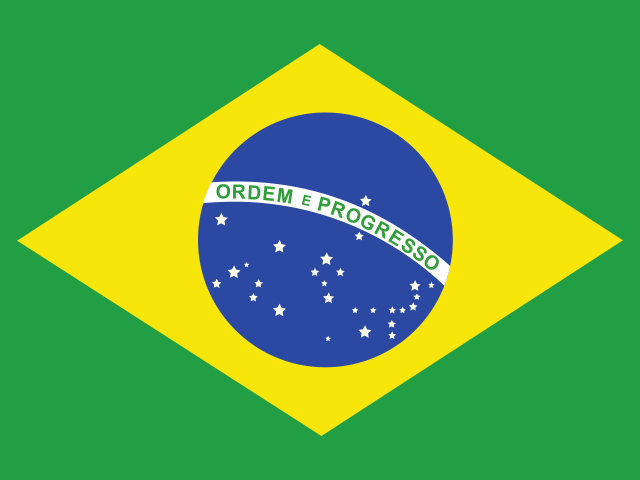
It is time to resume the offensive and inflict a defeat on denialism. Nature reminds us every day that we live on one planet. The glaciers in the Himalayas are melting. The super El Nino may cause torrential rains, droughts and forest fires in different parts of the globe. Its effects will hit the most vulnerable, the hardest. Brazil has been demonstrating that it is possible to combine economic growth with reduced emissions. We have achieved our self-sufficiency in oil and will continue to explore the potential of new reserves, such as those in the equatorial margin. But we will not abandon the environmental agenda. We will move forward with the roadmap for the decarbonization of the Brazilian economy. The Tropical Forest Forever facility, launched at Cop 30 in the city of Berlin, shows that it is possible to change old paradigms. The forest is worth more standing than destroyed. We will continue to reduce deforestation, which has been cut in half in the Amazon and reaching its lowest level in 11 years. We have the moral authority to reject protectionist measures disguised as commitment to the environmental cause. Brazil is a global reference in green energy. We have the critical minerals and the rare earths that the world needs to make the energy transition. Our natural wealth belongs to the Brazilian people, and it is in their benefit that it will be exploited.
During this dialogue, I sense the enthusiasm of young people and women to build a community with a shared future in the spirit of Ubuntu. In these young people, I sense the desire to connect with one another and to live together, side by side. But unfortunately, there are still states that prevent their citizens from living together with other peoples as brothers and sisters. They cultivate and perpetuate xenophobia and intolerance. They sow division by failing to implement preventive and corrective measures, by highlighting disparities in development, labeling some as rich and others as poor, and thereby creating a divide among peoples based on wealth and material possessions. And on that basis, they have come to regard themselves as saints while reproaching others for being inferior. How, then, can we build trust among nations without first starting with building connection and cohesion among our peoples? We, the leaders, must rekindle the spirit of Ubuntu within ourselves, the Ubuntu with which God created us. Indeed, God did not create a man who was selfish. He created a man of Ubuntu, the Ubuntu that I see in you and that you will find in me. Ubuntu is the common denominator that must restore trust among all human beings. Excellencies, as an African and a voice for Africa at this time when I hold the rotating chairmanship of the African Union, I must also state the following: we are here to convey a conviction. Africa must be listened to more. It must be better represented and more closely involved in the decisions that shape the future of our planet. This is what must build trust between Africa and other continents, as well as with international institutions. We no longer wish to see the Human Rights Council become a forum for oppressing countries that are deliberately singled out because they defend and fight for the interests of their peoples. We want to see this council working for justice and equity for all states, without distinction. International human rights law must apply without exception to all states of the world, both in its corrective function as well as in its regulatory function. The Human Rights Council cannot be instrumentalized by other countries to the detriment of others, given that all member states of the United Nations enjoy a status of sovereign equality. Burundi wishes to reiterate, once again, its opposition to the imposition of a special rapporteur on the situation of human rights in Burundi, who was appointed without any prior dialogue or consultation. Burundi is a responsible country that respects human rights. It has fought impunity for decades. It upholds the rights and freedoms of all and ensures security as well as the guarantee that crimes it has experienced in the past will not be repeated. Mr. President, Africa intends to be a full-fledged actor and not a mere observer called upon to applaud decisions in whose preparation it played no part.
Chile understands that in a multipolar world, institutional stability is not a luxury, it is a need. For example, we are a pioneer in the energy transition. Chile possesses around a quarter of global lithium reserves, and we are the largest producer of copper on the planet. Chile has a lot of sunlight, the heat of the sun, a long Pacific coast, lakes, rivers, volcanoes that can create vast stores of energy. Chile also has the Strait of Magellan, a crucial alternative route for global trade. Our nation will become the bridge and the port for the bioceanic corridors that will unite America with Asia. This richness, this wealth is not only fortune that we have in our coffers, it brings with it responsibility. Responsibility to you. Chile will never renounce its sovereignty. Neither will it cease to exploit its own minerals. We have our sovereignty, of course, but at the same time, we say that the energy of the future must serve humankind, and energy must not be held hostage by monopolies or actors that do not abide by the rules. Please make no mistake here it is possible to reconcile growth and sustainability. The two are inseparable. Chile understands that environmental protection and economic progress form part of one single development strategy one in which investment and innovation are linchpins when it comes to improving the quality of life of our people. Sustainable development requires robust institutions, clear rules, timely decisions and effective administration able to turn commitments and diagnoses into tangible results for both people and the environment. President, I now wish to turn to a discussion of our continent, Latin America, because I sincerely believe that the coming decade can be ours.
But the United Nations must also remain a place where ambition can become action. Mr. president, we must also confront the serious challenges facing the Sustainable Development Goals. The SDGs represented a promise that by 2030 we would make meaningful progress in ending poverty and hunger, improving health and education, advancing equality, protecting our planet, and building more peaceful and inclusive societies. Today, that promise is at risk. Conflict, climate change, debt distress, inflation and persistent inequality have pushed the goals further out of reach for many developing countries. But this is not the time to abandon the 2030 agenda. It is the time to renew our commitment and concentrate on delivering results that people can see and feel in their daily lives. For Dominica, we have incorporated the SDGs as priorities in our National Resilience Development Strategy 2030, our Climate Resilience and Recovery Plan and our wider development agenda. We see sustainable development in the homes we have built for vulnerable families; in our investment in geothermal energy as cleaner, more affordable and reliable energy. We see it in our efforts to strengthen education, expand technical and vocational training, and better prepare our young people for the world of work. We see it in our support for farmers, entrepreneurs, agro-processors and tourism operators who are creating jobs and building stronger local industries. We also see it in our work to protect our forests, marine resources and natural environment. For Dominica, these resources are part of our identity, but they are also essential to our food security, our tourism product and the livelihoods of our people. Excellencies, the challenges before us cannot be overcome by any one country acting alone. They require a strong and effective United Nations, renewed international cooperation and a firm commitment to multilateralism.
Mr. president. Mr. president, we find ourselves at a critical juncture in the history of the United Nations. The organisation is facing significant challenges both internally and externally. Internally, there is the process launched by the Secretary General to update the administrative and financial structure of the organisation, to allow our organisation to be better equipped to overcome future challenges. Externally, the role and the functions of the organisation, as well as the composition of its principal organs, are in doubt and need to be redefined. The will expressed by the international community following the war to create an instrument for cooperation in order to establish a new world order, is still there. The fact that the number of actors has more than tripled in the past eight decades reflects an engagement and commitment that is even bigger and even more diverse than it was when the UN was created. We are confident that the international community, around half of which is made up of young people that aim to protect the planet, that want to better share wealth and aspire to use new technologies advisedly, will be able to overcome new challenges. We reiterate our commitment to multilateralism, as well as our confidence in its ability to respond to people's expectations. Thank you, Mr. President.
Thus, Mozambique reiterates its support for the objectives of the UN Aid Initiative to make this organization more effective, coherent, inclusive, representative, and suited to the challenges of our time. Reform must be embraced as political commitment focused on concrete results. Reforms must also correct imbalances in representation of global governance. In this regard, Africa cannot continue to be in the center of the Security Council agenda while remaining absent from its rank of permanent members. Africa must be a permanent member of the Security Council of the UN. We therefore reaffirm the common African position related to the reform of the United Nations Security Council, based on the Ezoulini Consensus and the Search Declaration, under which no fewer than two permanent seats, with all prerogatives and privileges, including the veto, as long as it exists, and five non-permanent seats, are allocated to Africa. The contribution that Mozambique wishes to make to the debate on this Assembly has the objective of restoring trust through peace, managed transformation through inclusion, and produced results through coherent actions at the national, regional, and global levels. To this, it is important to strengthen international cooperation and equip the UN with greater capacity to address the challenges of the present and make sure that the future generations can have a stronger organization than the one we have received— an organization equal to the challenges of our time, capable of serving the people with dignity, protecting the planet, and promoting a shared prosperity at the international level. Your Excellencies, 81 years ago, the founders of this organization entrusted humanity with a promise of peace, cooperation, dignity, and, most of all, hope. Today, that responsibility falls to us, and the path remains very clear: dialogue, cooperation, partnership, innovation, solidarity, and continued strengthening to the role of the United Nations, and never the use of force in order to impose decisions. This organization is the most comprehensive expression of our collective responsibility and our commitment to multilateralism to the service of humanity. Mr. President, allow me to conclude by returning to the opening words of our Magna Carta or Charter:" We, the people."
We're continuing the gradual expansion of universal health coverage, in particular through free maternity care, improved maternal and newborn care, vaccination, access to essential medicines, the strengthening of the healthcare workforce, and by expanding social protections. Mr. President, every health crisis confirms the same truth. Health sovereignty is built before emergencies. It is based upon accessible healthcare systems, robust epidemiological surveillance, high-performing laboratories, well-funded research, and above all, the trust of the population. In this regard, the Ebola virus outbreak caused by the Bundi Bugio strain remains a major test for our country. For the DRC, fighting this epidemic is an absolute priority. After having contained 16 previous outbreaks, the DRC is mobilizing recognized scientific and operational expertise. And thanks to national mobilization and the support of our partners, the response has recently begun producing tangible results. In addition, clinical trials are now underway to evaluate vaccines and treatments for this strain in particular. I'd like to pay tribute to the Congolese and foreign healthcare workers, researchers, communities, and our partners, especially the WHO and the Africa Centers for Disease Control and Prevention, or the Africa CDC, for their invaluable support to the DRC in eradicating this disease and strengthening resilience to it. Mr. President, this need for resilience does not stop at the boundaries of health. It is also vital when it comes to climate disruptions, whose effects are already putting our societies under growing pressure: flooding, droughts, and erosion, not to mention population displacement, are threatening our stability. In light of these upheavals, not all countries bear the same responsibility or the same burden. Those who contribute least to global warming often suffer the heaviest consequences. This paradox is all the more striking, given that some of these countries are also some of the main custodians of the natural assets upon which our common future depends. The DRC is one of these custodians. It is home to a vital part of the Congo Basin, which is one of the planet's greatest climate regulators. Its forests, peatlands, freshwater, and biodiversity provide humanity with considerable ecosystem services. This world heritage will continue to be preserved while we maintain that the communities that protect it ought to be able to benefit from it. Climate finance, in this regard, is a fair solution. However, it ought to be accessible, predictable, and proportionate to the services rendered. Indeed, climate justice cannot consist in further indebting those who already bear the cost of damage they did the least to cause. In the DRC, this ambition is taking shape, especially through the Kivu-Kinshasa Green Corridor, which combines ecosystem preservation, economic development, and improved living conditions of the people. Generating 60 megawatts of electricity, this initiative also aims, by 2027, to create 25,000 jobs and protect 5,000 square kilometers of natural forest. The climate crisis is also a water crisis. Following the African Water Forum held in Jamena in July, the DRC has proposed the creation of an African Coalition for Water Security, which aims to strengthen regional cooperation and mobilizing the financing needed to make water a driver of development and for the prevention of tensions. Mr. President, these transformations require considerable resources. Four years from the 2030 deadline, the Congolese roadmap for accelerating the SDGs estimates our needs at more than $70 billion.
Mr. president, those who have declared climate change a hoax perpetrated by geopolitical opponents. The warnings of recent times cannot have been clearer. Melting glaciers, flash flooding, droughts, record breaking heat waves, brush fires, hurricanes and other extreme weather phenomena are unmistakable signs of an overburdened planet. Climate change is the ultimate test of global equity. We in Africa contribute less than 4% of global greenhouse gases, and yet we bear some of the heaviest burden of climate devastation. We face erratic rainfall, our coastal towns suffer relentless erosion, and our Sahelian region faces accelerating desertification. On 29th June this year, Ghana and coastal West Africa faced an unprecedented deluge. Torrential rain exceeding 160mm was dumped on coastal regions of Ghana within 24 hours, resulting in 39 deaths and one still unaccounted for. And so climate justice demands that developed nations must fulfill their long overdue financial commitments. Mitigation support must be operationalized with predictable non-debt, creating grants, not loans that further in debt fragile economies. Similarly, global health security demands true solidarity because pathogens do not respect national borders, they just walk across without visas. We must build an equitable global health architecture that guarantees regional manufacturing of vaccines and therapeutics, strengthen epidemic surveillance, and funds resilient public health infrastructure across the global South.
The Iranian people will be free. Their murderous regime will be toppled by its lies, by its corruption, by its cruelty. This evil regime will fall, and we will all celebrate that day. Ladies and gentlemen, the story of my people, the Jewish people goes back over 3000 years. We speak the same language. We speak the same language today that we spoke then. We live in the same land in which our ancestors lived. Then David, Solomon, Isaiah, Jeremiah, that's our land, the land of Israel. Our prophets, our purpose, and our people are unique in history. Our values have inspired humanity for millennia The belief in one God, the sanctity of life, the rule of law, our eternal quest for peace, our eternal quest for justice. It is these sacred values that propelled us throughout the ages. It is these values that helped us beat the odds of history. The great American writer Mark Twain said it best 125 years ago. He said it well before the rebirth of the modern Jewish state, well before the great victories of Israel's soldiers. Here's what he said. The Jew is made a martyr. The Jew has made a marvelous fight in this world in all the ages, and he has done it with his hands tied behind his back. The Egyptian, the Babylonian and the Persian rose filled the planet with sound and splendor, then faded to Dreamstuff and passed away. Other peoples have sprung up and held their torch high for a time, but it burned out. And they sit in twilight. The Jew saw them all beat them all. And is now what he always was, exhibiting no decadence, no infirmities of age, no weakening of his spirits, no slowing of his energies. Ladies and gentlemen, over the centuries, the tyrannies that tried to destroy us failed time and again. And God willing, they'll continue to fail if we muster our courage. If we steal our resolve, we will continue to win, as the Bible says. Netzach Israel, the eternity of Israel will not falter. And the reason is simple. We have no other choice.
This session of the General Assembly is convening on the eve of the 65th anniversary of Mongolia's full fledged membership in the United Nations. In 1961, Mongolia made history by raising its national flag with the Golden Soyombo at the United Nations and becoming the 101st member of the United Nations, the guarantor of global peace and security, and the beacon of hope and trust for the world's nations. Mongolia welcomes the convening of the 81st session of the United Nations General Assembly under the theme Restoring Trust Managing Transformation a United Nations that Delivers for all, reaffirming its belief in the central role of the United Nations in fostering mutual trust, mutual respect and cooperation among the nations and peoples of the world. Mongols say if you do your best, fate will do the rest. The United Nations is an organization based on the trust and commitment of each member state, and the UN is strengthened by their dedication and sustained efforts. Therefore, it is incumbent upon us, Member States to uphold the mission of the United Nations with a sincere heart. Rather than simply expecting support and assistance, we must remain deeply conscious of our own responsibilities and duties and dedicate our wholehearted efforts to strengthening the United Nations. It is through trust and hope, dedication and commitment and engagement and participation of every Member State that we can strengthen the United Nations. A stronger United Nations, in turn, will deliver more efficiently towards global peace, security and sustainable development, thereby creating conditions for all Member States to benefit. As the conflicts and confrontations flash across the world, the walls of distrust rise higher and the chasm of misunderstanding grows deeper, it is becoming crucial to shape and develop international relations, not through a form of multipolarity that risks driving the world toward division, but through a multi-pillared principle that respects the pluralism inherent in each nation's history, culture, civilization, core national interests and chosen path of development. Eight centuries ago, our ancestors established the great Pax Mongolica, promoting, for the first time the idea to the world that nations could mutually recognize one another's values, and that peoples of diverse civilizations and faiths could coexist. This historic contribution of the Mongols to the advancement of humankind continues to be recognized by the international community. Let us strengthen multilateral cooperation through the multi-pillar principle, inspired by the ideas of Pax Mongolica, so that we may restore our trust and hope through shared responsibility, reform the United Nations with a common purpose and build a better, more peaceful world through the strength of our collective action. Mr. President, despite the remarkable heights of development and progress humanity has reached, our planet is currently confronted with more than 90 armed conflicts, around 30 of which are international, demonstrating that global peace and security remain unstable and that geopolitical and geostrategic competition continues to intensify. This results in the disruption of global economic supply chains, a rise in the prices of energy, fuel, raw materials and food, as well as economic strains on nations around the world. All of this is weakening the international order established since the Second World War, changing the universally recognized norms of international law and undermining the stability of multilateral relations and cooperation. Mongolia shares the view expressed by United Nations Secretary General Antonio Guterres in his annual report on the work of the organisation that in a world marked by turbulence, division and uncertainty, the United Nations is more necessary than ever. Hence, Mongolia underscores the tangible progress made under Secretary General's UN80 initiative to improve the effectiveness and efficiency of the United Nations in response to the challenges of our time and reaffirms its active support for this initiative. The effectiveness of the United Nations, the decisiveness of its actions, and the ability of nations to unite their efforts will ultimately depend upon us, the Member States. Mongolia is confident that the soon to be appointed Secretary General will steadfastly uphold the principles and purposes of the United Nations and international law, ensure that the voices and positions of all Member States are equally heard and reflected, and provide strong leadership in restoring trust and managing transformation within the UN. Believing that reform of the Security Council should be at the core of broader United Nations reform, Mongolia maintains its principled position in support of expanding the number of both permanent and non-permanent members of the Security Council ensuring equitable representation of developing countries in the Council, and promoting greater openness and transparency in its work. Mongolia is one of the 58 countries that have never served as a non-permanent member of the United Nations Security Council. Therefore, Mongolia aspires to actively participate in the work of the Security Council and contribute to finding collective solutions to the problems and challenges facing the international community. In manifestation of this aspiration, I officially announce from this rostrum today that Mongolia is presenting its candidature for a non-permanent seat of the UN Security Council for the term 2048 2049. Mr. President, on behalf of the people of Mongolia, I extend my heartfelt gratitude to the United Nations and its system organizations for their valuable contributions to our country's development and progress and their long standing, constructive cooperation over the 65 years since Mongolia's accession to the United Nations as a full fledged member. Mongolia has been contributing with honor to the efforts on strengthening international peace and security, advancing social and economic development and protecting human rights, the core pillars of the United Nations. For instance, more than three decades ago, in pursuit of its foreign policy to ensure national security through political and diplomatic means, Mongolia declared its territory nuclear weapon free. Since then Mongolia has consistently pursued policies and taken actions to verify the status legally. In this spirit, the United Nations General Assembly adopts on a biennial basis the resolution entitled Mongolia's International Security and Nuclear Weapon Free Status, initiated by Mongolia in 1998.
Mr. president, the theme of this session, Restoring Trust, Managing Transformation: a United Nations that delivers for all, perfectly chimes with the concerns of those peoples aspiring to peace and progress, even while bombs and other devices of mass destruction are endlessly causing death and devastation in every corner of our planet. How can we restore trust and manage transformation in the world, so that the United Nations can effectively bring peace and good fortune to all peoples? How then, can we achieve this goal? I would recall that our previous session called upon us to act better together. That message remains just and it remains relevant, but it requires us to take stock to look at what has been accomplished and to acknowledge what has not been accomplished. Because trust is not built through more and more promises, but rather through their effective implementation for the benefit of the peoples. Excellencies, ladies and gentlemen, trust cannot be decreed. It is built, it is earned, and it requires truth and justice. How to restore trust when for decades, propaganda has been used to maintain the idea of a poor Africa condemned to do everything it is told to do to survive, thanks to the assistance of supposed international generosity, even while its resources, its riches are stolen and locked away for the benefit of other agendas. How to restore this trust when the international institutions that are supposed to protect us have become the tools of a world order in which some peoples count and others merely survive, and in which international law does not apply equally to all. What can we say of the crimes committed in Libya, in Iraq, in Palestine in Lebanon, in Cuba, in Venezuela, and in our Sahel, the Sahel, in the name of supposedly universal values, which nevertheless remain unpunished. Those crimes, even while sovereign nations are threatened with sanctions for simply having wanted to decide on their own fate. Niger, my country is following with deep concern the tragic situation in Palestine, particularly in Gaza where civilians are paying an unbearable human cost. We call for the effective protection of civilian populations, for unhindered humanitarian access, and for the pursuit of just and lasting peace. Niger reaffirms its support for a two state solution, allowing the State of Palestine and the State of Israel to live side by side in peace, security and dignity. How to restore trust when 81 years after San Francisco, Africa, with its more than around 1.5 billion inhabitants and its 54 states, still does not have a single permanent seat on the Security Council. Through me, Niger reaffirms its commitment to the Ezulwini Consensus and calls for this historic anomaly to no longer be the subject of sterile debates, repeated day after day to at long last, become subject to a full and concrete decision. Excellencies, Mr. President, ladies and gentlemen, our Sahel is at war. It is in a war of liberation against a conspiracy aimed at recolonizing it. What is happening in the Sahel is not merely not simply an armed rebellion or a war of religion, nor is it the inevitable result of our own weaknesses, what some call terrorism in our region is the cynical machinery of recolonization dressed in the trappings of extremism.
I selected 10 sentences for peace for the United Nations General Assembly, giving them a voice. And I begin, and I quote," From a country that has learned from war, Timor-Leste sends a message to the world. That is, peace is not just a dream, but a decision that we all have to choose." By Olguita, 16 years old. We may look different, speak different languages, and come from different places, but we all bleed the same color. So why should our differences divide us? By Elizabeth, 16 years old." May we build a world where no child learns the sound of war before the sound of laughter, and where no dream is buried because someone else's hatred." By Emily, 16." Why should we choose hate and war when love is a choice?" By Ira Bela, 12 years old." My voice may be small, but my request is simple. Let children grow up knowing the sound of peace, not the sound of war. Let them inherit schools, homes, and opportunities, not fear, destruction, and hatred. Let the leaders of today give the children of tomorrow a reason to believe in peace." By Victoria, 12 years old." Let our differences be bridges between hearts, not walls between nations, so that every child can grow knowing the sound of laughter instead of the sound of war." Natalia, 17." Let every weapon fall silent so every child can grow up knowing the sound of peace." By Christian, 16." I only think that peace in the world begins within us. When we learn to love each other unconditionally, forgive sincerely, and respect each other despite our differences, the world will become a place full of peace, hope, and love." By Melchi Videau, 12 years old." Peace is not merely the silence after conflict. Rather, it means we overcome everything peacefully. Let peace be the victory we seek and create a unity for humanity." By Clarissa, 14." Peace never exists on its own, but begins with us." By Francisca, 14." For all the people who rule the world, children should not have to learn about all the worlds in our history class. We should learn about the names of the stars, the names of peacemakers, and how to reach planet Mars with deep, deep respect." Solomon.